oncrosser judges every hop against the road's real traffic. Whether a road can be crossed at all is decided by the round's seed before you see it; how you fare on a crossable road depends on your timing. No timing makes a road with no way through crossable, and no road that has a way through is out of reach for a player who times every hop perfectly.
Who judges each hop
A hop is sent with a tap, key press or swipe, together with the moment it was made. The device does not get to declare whether the hop was safe; the round service replays it against the round's traffic with the same rules and code.
At settlement, the backend replays the whole round again from the seed and the recorded hops and rejects any result that does not match. This keeps every outcome on the authoritative game path instead of accepting a browser-supplied result.
The current road rules
The table below shows the standard public configuration reviewed for this article. The values are rule constants of the current version and are the same on every road.
Rule | Current value | What it means |
|---|---|---|
Width | 9 columns | The piece moves one column left or right, or one row forward or back. |
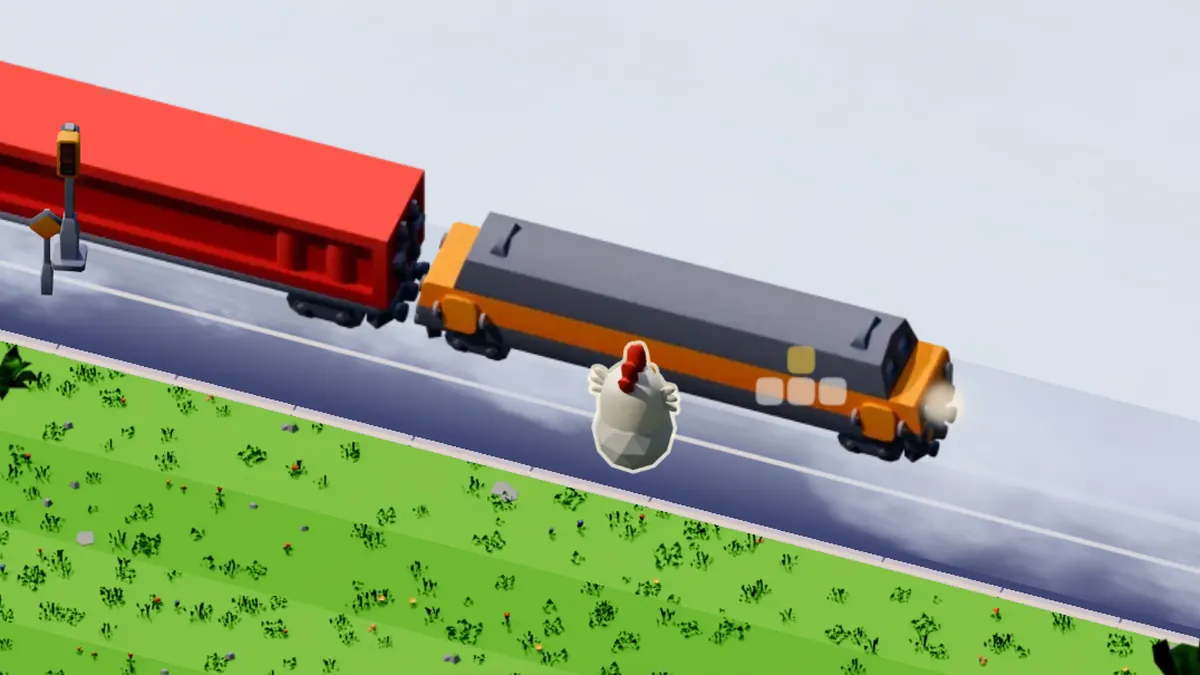
Lanes per road | 4 | Each lane is cars (about 60%), a river with logs (about 20%), or a railway (about 20%). |
Car speeds | 1.5, 2 or 4 cells per second | Each lane has its own steady speed; no car ever speeds up or reacts to you. |
Trains | Warning lights 2.5 seconds before | A train is announced before it reaches the crossing. |
Hop | 0.15 seconds | One press is kept if you press during a hop and is carried out when you land. |
Chaser | Reaches the grass 5.2 s after you land, then 1 row every 1.5 s | It only follows; it never pushes you. |
Car gaps and log lengths are drawn within these rules, so two roads rarely look alike. These values must be reviewed with the article whenever the game rules change.
How a blocked road is decided
For each road, the round's seed first draws whether that road has a way through, with the exact published chance for its strip. The traffic is then drawn, and redrawn if needed, until it agrees with that decision when every column of the grass row is checked at the moment the road opens. Nothing you do enters the draw: not when you land, not where you stand, not your past results.
Strips 1 to 5: chance of no way through = 1 in 21 (about 4.76%)
Strips 6 to 11: rising step by step to 15%
Strip 12 onwards: chance of no way through = 3 in 20 (15%)
The blocked chance and the house edge are different concepts. A 15% chance that a road has no way through does not mean the game has a 15% house edge: each strip's multiplier is set from these same chances so that perfect play returns exactly the stake on average.
An example on the first road
Road 1 currently has a 1 in 21 chance of having no way through. Its grass strip pays ×1.05.
Situation | Chance | What happens |
|---|---|---|
The road has a way through | 20 in 21 (about 95.24%) | A player who times every hop perfectly crosses it; a mistake can still end the round. |
The road has no way through | 1 in 21 (about 4.76%) | Nobody can cross it, however well they play. |
These are calculation examples, not observed win rates or forecasts for a player. Read the separate explanation of 0% house edge and the ladder for the relationship between a strip's chance and its multiplier.
Why you decide before you see the road
When you land on grass, the cash-out window opens. You can see the first lane of the next road; its other lanes are covered by mist and are not sent to your device. The window closes at your first hop or 0.3 seconds after you land, and only then does the mist lift.
That is why nobody can look at a road and then decide whether to cash out. Everyone decides first and sees second, so no player can pick only the easy roads and the published chances hold for every player.
What a hit means
A car or train reaching the piece, falling in the river, or the chaser reaching the piece's row ends the round. A hit is final even on a road that had a way through: the road was crossable, but not on the moves that were made.
Conversely, a careful crossing is not an automatic win: every new road carries its own published chance. This is why oncrosser should not be described as a chance-free game.
What timing does not prove
Perfect timing does not guarantee crossing a road or a profitable round.
Timing does not remove the published chance that a road has no way through.
The road rules are game constants, not a promise about any one road's traffic.
The blocked chance is not an additional published house-edge percentage.
One result does not predict the next round or establish a player's long-term outcome.
oncrosser involves real-money gambling and the full stake can be lost. Review the game and risk disclosures and use the available responsible-gaming controls before playing.
Methodology and change control
This article was reviewed on against the live public rule set, the generator specification of rule set oncrosser-v2.2, and the matching hop and settlement replay on the device, the round service and the backend.
The figures describe the standard public configuration, not independently measured player results. If lane rules, speeds, the hop, the chaser, the cash-out window or the published chances change, the examples and last-reviewed date must be updated.