oncrosser's 0% house edge describes the published relationship between each strip's chance of being reached on perfect play and its multiplier. It does not mean a round is safe, that every player has the same outcome, or that losses cannot occur.
What the 0% house edge claim means
The active oncrosser rules publish, for every strip, the exact chance that its road has no way through. The multiplier of each strip is then calculated from those chances alone. In other words, the probability and multiplier are calibrated together rather than having an additional percentage removed as a house margin.
This is a statement about the published ladder. It is not a prediction for one round, one player, or one session. A player can still be hit on the first road, lose a full stake, or reach a multiplier and then lose it by carrying on instead of cashing out.
The calculation
Each road has a chance of having a way through. The chance of reaching a strip on perfect play is the product of those chances for every road up to it, and the strip's multiplier is the reciprocal of that product.
Chance of reaching strip n on perfect play = (1 − p1) × (1 − p2) × … × (1 − pn)
Multiplier of strip n = 1 ÷ chance of reaching strip n
Expected factor on perfect play = chance × multiplier ≈ 1.00
For strip 1, the chance that the road has no way through is 1 in 21. The chance of reaching strip 1 on perfect play is therefore 20 in 21, about 95.2381%, and the multiplier is 21 ÷ 20 = 1.05.
The ≈ symbol matters: published multipliers are rounded down to four decimals, and this explanation is for a player who makes no mistakes. It is not a guarantee that a player will receive their stake back.
How to read the ladder
Higher strips pair a larger multiplier with a lower chance of being reached. The house edge stays at 0%, but the chance of crossing the next road does not stay constant.
Grass strip | Chance the road has no way through | Multiplier | Chance of reaching it on perfect play |
|---|---|---|---|
1 | 4.76% | 1.05× | 95.24% |
5 | 4.76% | 1.2762× | 78.35% |
10 | 10% | 1.8422× | 54.28% |
12 | 15% | 2.4713× | 40.46% |
20 | 15% | 9.0693× | 11.03% |
30 | 15% | 46.0666× | 2.17% |
50 | 15% | 1,188.5249× | 0.0841% |
100 | 15% | 4,018,481.9022× | 0.0000249% |
The multiplier is the value paid at the named grass strip. It should always be read alongside the next road's chance, never in isolation. You can review the live public table in the How it works section before placing a bet.
Where timing changes the round
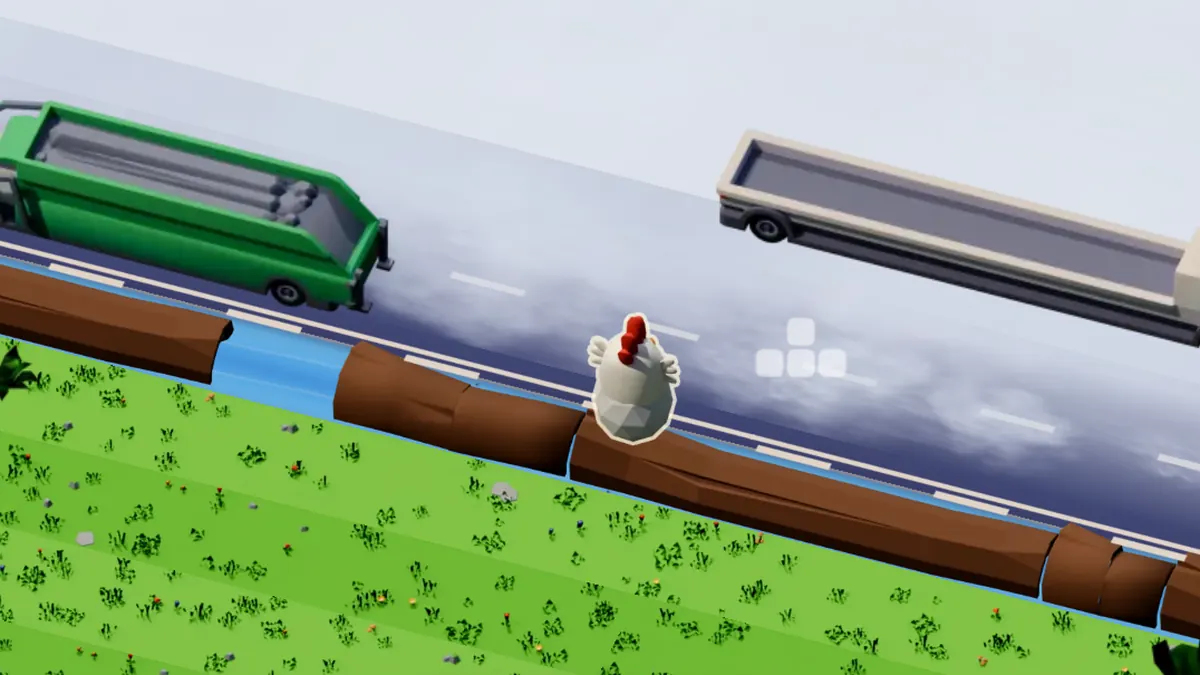
The ladder is only one part of oncrosser. Every hop is judged against the road's real traffic, and a car, a train, the river or the chaser ends the round on a mistimed move, even on a road that had a way through.
That is why "0% house edge" and "skill matters" can both be true. The ladder does not include a house margin, while the player's timing decides how often a crossable road is actually crossed.
What 0% does not mean
It does not mean there is no chance or variance.
It does not mean every round, player, or session will break even.
It does not mean a high multiplier is likely to be reached.
It does not remove the consequences of a mistimed hop.
It does not make real-money play risk-free or guarantee a profit.
oncrosser is a real-money gambling product. Read the game and risk disclosures for the product's current risk statements and availability limits.
What to check before you play
Read the next road's chance and the multiplier together.
Choose a stake you can afford to lose in full.
Decide in advance when you will cash out, and set a session limit.
Stop if play stops being entertainment.
oncrosser provides information about responsible gaming and account limits. For gameplay questions, use the FAQ or contact support.
Methodology and change control
This article was reviewed on against oncrosser's live published ladder (oncrosser-v2.2-ramp-c) and the matching calculation in the round service and backend. Percentages shown in the table are rounded for public display.
If the active rules or the published ladder change materially, this article's last-reviewed date and examples must be updated with them.