What makes a game a game of skill
A game qualifies as a game of skill when what the player does measurably changes the expected result. Chance can still be present. The test is whether two players of different ability, playing the same game for long enough, end up with different outcomes.
That splits into two very different abilities, and most real money games only test one of them.
Judgement. Reading a situation and choosing the better option. Poker, blackjack and sports betting are judgement games.
Execution. Physically performing an action accurately, under time pressure. Reaction speed, timing and hand-eye coordination.
Judgement-based skill gambling is common. Execution-based skill gambling is rare, because most casino formats give you a button and a result, with nothing in between that your hands can influence.
Hand-eye coordination as a measurable casino skill
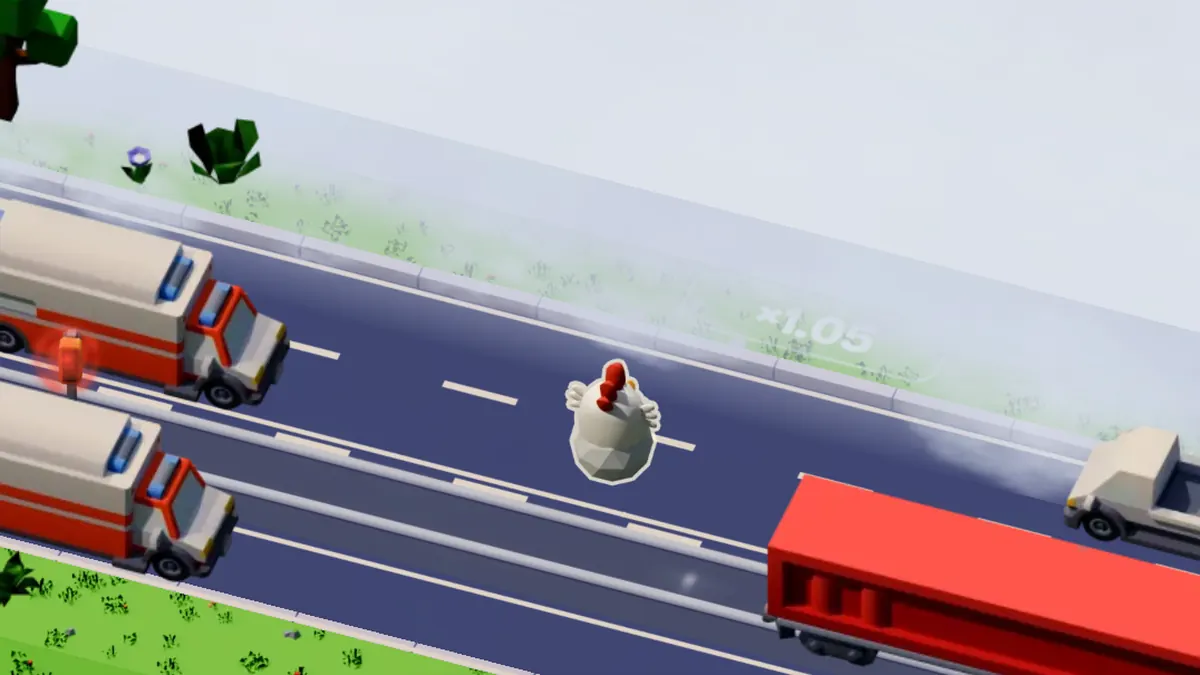
The road-crossing game is built the other way round. Cars, logs and trains move across each road at steady speeds, and you hop one square at a time through the gaps. Every hop is checked against the road's real traffic, and that check is the whole game.
Each lane keeps its own steady speed of 1.5, 2 or 4 cells per second, and cars are 1 to 5 cells long. A hop takes 0.15 seconds, so every hop is a small prediction: where the gap will be when you land.
Landing in those gaps is a genuine motor task. It is the same order of precision as a rhythm game or a fighting game input window, and it is trained the same way: repetition until your hands stop guessing. Every hop either lands safely or ends the round, so improvement is visible rather than assumed.
What timing precision is actually worth
Because the base game carries no house edge, mistakes are the only thing that create one. A road that has a way through can be crossed by a player who times every hop perfectly, and a mistake on it ends the round, under the live road rules.
A hop timed into a real gap costs nothing.
Hopping into a car lane a moment too early, or misjudging where a log will be, ends the round with zero.
Waiting too long for a perfect gap lets the chaser reach your row, which also ends the round.
A road with no way through ends the round whatever you do. That is the published chance, not a mistake.
Those mistakes look rare. Compounded across a round they add up. Modelled on the published ladder, assuming a player makes a round-ending mistake at one steady rate on every road that has a way through, and cashing out at strip ten, the return works out as follows.
No mistakes: 100 percent return, and you reach strip ten 54.3 percent of the time.
A mistake on one road in 100: about 90 percent return, reaching it 49.1 percent of the time.
A mistake on one road in 50: about 82 percent return, reaching it 44.4 percent of the time.
A mistake on one road in 20: about 60 percent return, reaching it 32.5 percent of the time.
Ride further and the gap widens sharply. Cashing out at strip twenty, perfect play still returns 100 percent, a mistake on one road in 50 returns about 67 percent and one in 20 about 36 percent. The difference between a player who reads every gap and a player who is close but casual is not a rounding error.
No other casino format works like this. A slot pays the same whoever presses the button. Here your hands set the number.
Skill versus chance
A game of chance pays out on a distribution you cannot touch. Roulette does not care how well you spin. Slots do not care how you press. Nothing you learn changes the maths.
Skill gambling means part of the result is yours. In a judgement game that part is which bets you take. In an execution game it is also how well you perform the action. The road-crossing game is both: you choose how far to cross, and you decide how cleanly each hop lands on the way.
Chance has not been removed. Every road carries a published chance of having no way through whatever you do, and a flawless crossing can still end on a blocked road. What precision changes is how much risk sits on top of that published number.
Types of skill-based games
Judgement games such as poker and blackjack, where decisions change expected return but your hands do nothing.
Sports and esports betting, where knowledge and modelling set the edge.
Daily fantasy contests, scored on selection rather than execution.
Arcade redemption and skill-with-prize machines, where physical accuracy pays out.
Timing-based crypto casino games such as the road-crossing game, where every action is checked against published rules.
The last two are the only common categories where hand-eye coordination is the skill being tested. Everything above them rewards thinking; those reward doing.
How skill games are regulated
Regulators generally separate games of skill from games of chance by asking whether skill predominates over chance in determining the outcome. Where the line sits varies by country and sometimes by state, and a game can be treated as gambling in one place and as a contest in another.
oncrosser is operated as a real money gambling product and treated as such. The skill element changes the returns, not the classification. Play only where it is lawful for you to do so.
How skill and chance work on oncrosser
oncrosser is a timing-based skill game played for real money. Each road carries its own published chance of having no way through, and each grass strip its own multiplier, both visible in the published ladder before a round begins.
Your timing decides whether each hop lands safely: reading lane speeds and car lengths, judging logs, heeding the train warning and keeping ahead of the chaser. Because the underlying maths is set at zero house edge, mistake-free play is worth exactly what the numbers above say it is worth. Hand-eye coordination is not a flourish on top of the game. It is the mechanism by which the game pays you.
Chance still sets the floor. A perfect crossing can meet a blocked road, and no amount of practice removes the published risk. Two things sit under your control: how cleanly you cross, and when to stop and cash out. When you land on grass, a cash-out window of 0.3 seconds opens with only the first lane of the next road visible, so you decide before you see the rest. Timing decides the odds you face on the way; the cash-out decision decides which of those odds you actually take.
Every completed round can be independently verified afterwards, so the random element is checkable rather than taken on trust, and a full round can be replayed start to finish.
Common questions about skill and luck
Does hand-eye coordination really change what you win?
On oncrosser, yes, and by a large margin. Modelled on the published ladder, cashing out at strip ten returns 100 percent to a player who never makes a mistake and about 60 percent to a player who makes a round-ending mistake on one road in 20. The roads are identical. Only the timing differs.
Is skill-based gambling still gambling?
Yes. Money is staked on an outcome that is not certain. Skill changes the distribution of results; it does not make them safe, and a skilled player can still lose many rounds in a row.
Can you win consistently at games of skill?
Skill raises expected return, and where the base game carries no house edge, precise play can reach a break-even expectation. It does not produce guaranteed profit, and variance across short sessions is large enough to swamp skill entirely.
Can you actually train for it?
Precision timing improves with repetition in the same way it does in rhythm and fighting games. Every hop gives its answer straight away, a safe landing or the end of the round, which is the feedback loop practice needs. Improvement shows up as fewer mistimed hops, fewer misjudged logs and more roads crossed.
What is the difference between skill games and slots?
A slot resolves on a random number the moment you press, and every player gets the same expected return. A skill game measures what you did. On a timing-based game the measurement is your timing, so two players on the same roads get different numbers.
Are real money skill games legal?
It depends where you are. Some jurisdictions treat predominantly skill-based contests differently from chance-based gambling; many do not, and the test varies. Check what applies to you before playing for money.
Playing responsibly
Precision raises your return but it does not remove risk, and the compounding works in both directions. Stake only what you can afford to lose, and use the deposit limits, cooldowns and self-exclusion controls if play stops feeling like a game.