People use "reflexes" to describe almost anything done quickly with the hands. Scientists and coaches split it into different abilities, and the split matters, because one of them barely improves with practice while the other keeps improving for years. If you play timing games, or any sport with a moving ball, the one that keeps improving is the one worth training.
What reaction time is
Reaction time is the delay between something unexpected happening and your body starting to respond: a light changing, a starter's gun, a car braking in front of you. For most adults, a simple visual reaction takes roughly 200 to 300 milliseconds, and you can measure your own with a free reaction time test. Sound is processed slightly faster than sight.
Reaction time is largely a property of your nervous system. Practice with a specific signal helps a little, fatigue and alcohol make it worse, and it drifts slowly upwards with age. What it cannot do is get dramatically better with training. A player who reacts in 260 milliseconds is not going to train that down to 120.
What hand-eye coordination is
Hand-eye coordination is the ability to track a moving object with your eyes, predict where it will be, and put your hand there at the right moment. A wicketkeeper taking a ball, a tennis player meeting a serve, and a gamer landing a precise input are all using it.
The crucial difference is prediction. When a target moves in a way you can read, your brain does not wait for it to arrive and then react. It projects the path forward and starts the movement early, so the hand arrives on time. That is why a good batter can hit a fastball that reaches the plate in around four tenths of a second: there is no time to watch and react, so the swing is built on a prediction made early in the ball's flight.
Predictive timing can be far more precise than reaction time. People who practise hitting a moving target on a steady rhythm learn to land within a few tens of milliseconds of the right moment, much tighter than the 200 milliseconds or more it takes to react to a surprise.
Mechanical skill: the layer on top
Coaches and gamers use "mechanical skill" for the repeatable, drilled execution of a movement until it happens without conscious thought. A golfer's swing, a drummer's timing and a fighting-game player's input windows are all mechanical skill. Its signature is consistency: not one brilliant attempt, but the same attempt to the same tolerance, again and again.
What a timing game measures
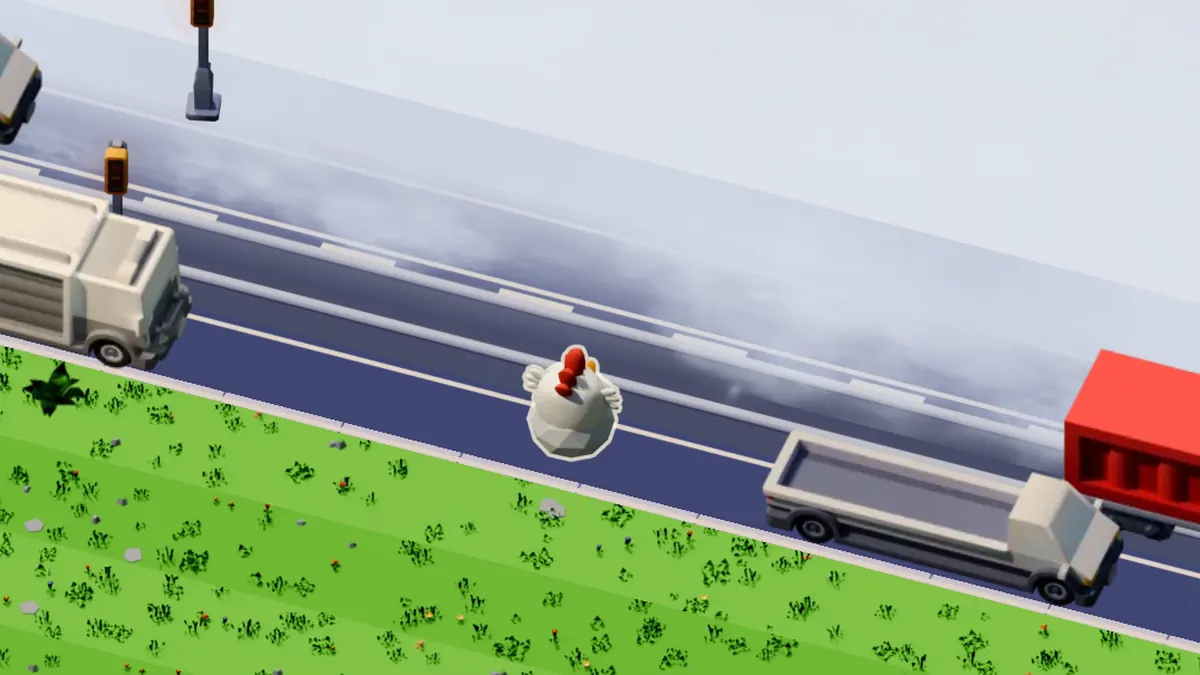
A timing game is a clean test of predictive hand-eye coordination. On oncrosser, cars, logs and trains cross the road in front of you, each lane at its own steady speed of 1.5, 2 or 4 cells per second. You hop one square at a time and each hop takes 0.15 seconds, so you are always predicting where a gap will be when you land, not where it is when you press.
A hop into a real gap lands safely and costs nothing.
A hop a moment too early or too late into a car lane, or onto water after the log has drifted past, ends the round.
A train is announced by warning lights 2.5 seconds before it arrives, many times longer than a typical visual reaction, so it rewards reading the signal rather than reflexes.
Nothing in that task needs reflexes. Cars never speed up or react to you, logs drift at a steady pace, and you can see each lane coming. Two parts are prediction under time pressure. The chaser reaches the grass you landed on 5.2 seconds after you land and then comes on one row every 1.5 seconds, so you cannot wait forever for a perfect gap. The cash-out window closes 0.3 seconds after you land, about as long as a typical visual reaction, so that decision has to be made before you land rather than after. The skill is predicting the gap and committing your finger to it, which is why players who practise improve.
Why it matters on oncrosser
Because the base house edge is zero, timing mistakes are the only thing that create a long-run cost. A road that has a way through can be crossed by a player who times every hop perfectly; one mistimed hop ends the round. Modelled on the published ladder, cashing out at strip 10 returns 100 percent of stakes for a player who never makes a mistake, about 90 percent for a player who makes a round-ending mistake on one road in 100 and about 82 percent at one road in 50. That gap is hand-eye coordination turned into a number, and it is what makes oncrosser skill gambling in the literal sense. The blocked roads and timing guide has the full rules.
How to train timing and hand-eye coordination
Train rhythm, not reaction. On any regular motion, count the beat and commit to it. Waiting to see the gap open makes you late by your whole reaction time.
Keep the setup identical. Same device, same hand, same posture, same distance from the screen. Mechanical skill is tied to the setup it was built in.
Practise in short blocks. Ten focused minutes beat an hour of tired repetition. Coordination is one of the first things fatigue takes.
Use feedback. Improvement needs to know whether you were early or late. A timing game tells you on every attempt.
Warm up. A few easy repetitions before anything that counts settle your timing.
Sleep and caffeine matter. Tiredness degrades timing more than people notice, and too much caffeine adds tremor.
Mix in other hand-eye activities. Juggling, ball sports, rhythm games and aim trainers all exercise the same predict-and-commit loop.
Common questions about hand-eye coordination and reaction time
Is hand-eye coordination the same as reaction time?
No. Reaction time is how fast you respond to something unexpected. Hand-eye coordination is how accurately you meet something you can see coming. Timing games mostly test the second.
What is a good reaction time?
For a simple visual signal, around 200 milliseconds is quick for an adult, and 250 to 300 milliseconds is typical.
Can you improve hand-eye coordination?
Yes. Unlike raw reaction time, predictive timing improves with focused practice and feedback, and keeps improving for a long time.
Does hand-eye coordination get worse with age?
Reaction speed slows gradually with age, but well-practised timing skills hold up much better, because they rely on prediction rather than raw speed.
What games improve hand-eye coordination for adults?
Any game with a moving target and a precise input: ball sports, rhythm games, aim trainers and timing games. The key is feedback on every attempt, so you know whether you were early or late.
Playing responsibly
Training your timing can make a skill game more rewarding. It does not remove chance: every oncrosser road carries a published chance of having no way through, even for perfect timing. Set a budget before you play, and use the limits and cooldowns if you need them. If gambling stops being fun, free and confidential support is available from organisations such as BeGambleAware and the National Council on Problem Gambling.