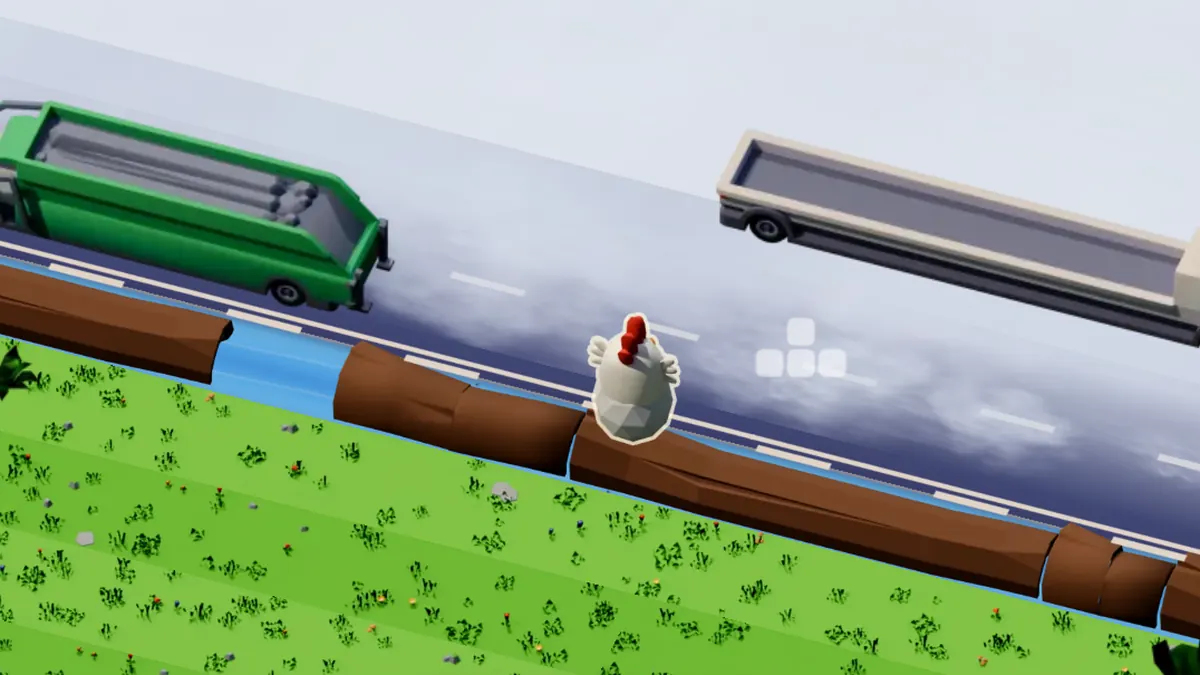
An oncrosser multiplier grows at each grass strip you reach. In-game cashout ends the active round at its current authoritative amount and sends that result for settlement. Carrying on instead leaves the current potential amount exposed to the next road.
In-game cashout is not a wallet withdrawal
In oncrosser, cashout is a game action. It ends an active round and settles the round's amount to the player's game balance. A withdrawal is a separate account transaction that moves an available balance through the supported withdrawal process.
Cashing out a round therefore does not mean that funds have already been sent to an external wallet. It records a terminal game result first. Withdrawal availability, verification, network processing, and account controls belong to the separate withdrawal flow.
How the multiplier grows
Every strip has a published multiplier. When the piece lands on a strip's grass, the round's current multiplier becomes that strip's multiplier. Published multipliers are exact fractions rounded down to four decimal places.
Current multiplier = the published multiplier of the grass strip reached
Multiplier of strip n = 1 ÷ the chance of reaching strip n on perfect play
The public table shows the value paid at each named strip. Under the configuration reviewed for this article, strip 1 is 1.05×, strip 10 is 1.8422×, strip 20 is 9.0693×, strip 50 is 1,188.5249× and strip 100 is 4,018,481.9022×. Those values are current configuration facts, not a statement that a player is likely to reach the later strips.
How the potential cashout amount is calculated
On a grass strip, the round service calculates the current round amount from the original stake and the strip's multiplier. The amount shown as potential cashout includes the original stake; it should not be described as profit.
Potential cashout amount = original stake × current multiplier
Potential net change = potential cashout amount − original stake
For example, a 10-unit stake at a 1.05× multiplier has a potential cashout amount of 10.5 units. The potential net change is 0.5 units, not 10.5. The settled amount is rounded down, never up; this example uses generic units because supported assets have their own display and settlement precision.
When in-game cashout is available
Cashout is available in the cash-out window that opens when the piece lands on a grass strip. While it is open you see the first lane of the next road; the other lanes stay under mist. The window closes at your first hop or 0.3 seconds after you land, whichever comes first, and then the mist lifts. Cashout is not available on a road, after the window has closed, or after the round has reached a terminal result.
A valid request must also identify the active authoritative round and come from the controlling player session. The service can reject a stale, duplicate, unauthorized, or otherwise conflicting request instead of applying it to a different round.
"Cash out anytime" is therefore too broad. The precise description is that a player can request in-game cashout on a grass strip while its cash-out window is open and the round remains active.
What authoritative settlement means
When a valid cashout is accepted, the round service finishes the round with its current multiplier and sends the result through the authoritative settlement workflow. The backend replays the whole round from its seed and recorded hops before it settles, and the player-facing event reflects the persisted round result rather than a new amount calculated only in the browser.
Settlement is designed to be repeat-safe, so retrying the same valid action does not create a second round payout. A temporary settlement delay is also different from a loss: the terminal result can already be recorded while the service completes authoritative confirmation.
If a result appears delayed or inconsistent, keep the round's commit hash and contact oncrosser support. Do not start a second action to guess around an unresolved status.
What remains at risk when you carry on
A current multiplier is not locked merely because it is visible. Hopping on keeps the round open. If the piece is then hit, lost in the river or reached by the chaser, the round amount becomes zero. The potential amount from the previous strip was never cashed out and is not paid separately.
Reaching the next strip increases the multiplier, but the next road also carries its own published chance of having no way through, and your timing still matters. Read how blocked roads and timing affect a round before treating the multiplier as the only relevant number.
Under the current 100-strip configuration, reaching the final strip automatically finishes the round as a win at the authoritative final amount. The final multiplier is a configured ceiling, not a guaranteed or typical outcome.
What cashout and multipliers do not promise
A large visible multiplier does not make the next road safe.
A potential cashout amount is not settled until the terminal action is accepted.
In-game cashout is not an external-wallet withdrawal.
The total cashout amount includes the stake and should not be labelled entirely as profit.
No cashout point guarantees a profitable session or prevents gambling loss.
Decide your stake and stopping point before a round rather than chasing an earlier loss. oncrosser provides responsible-gaming and account controls, and its game disclosures explain the real-money risks.
Methodology and change control
This article was reviewed on against the live published ladder, the cash-out window and payout calculation in the round service, and the backend's replay and settlement workflow. Public multiplier examples use the values of the current ladder.
Cashout availability, the window, the last strip, the multipliers, settlement behavior, and supported assets can change. A material rule or workflow change requires a factual review, updated examples, and a new last-reviewed date before republication.