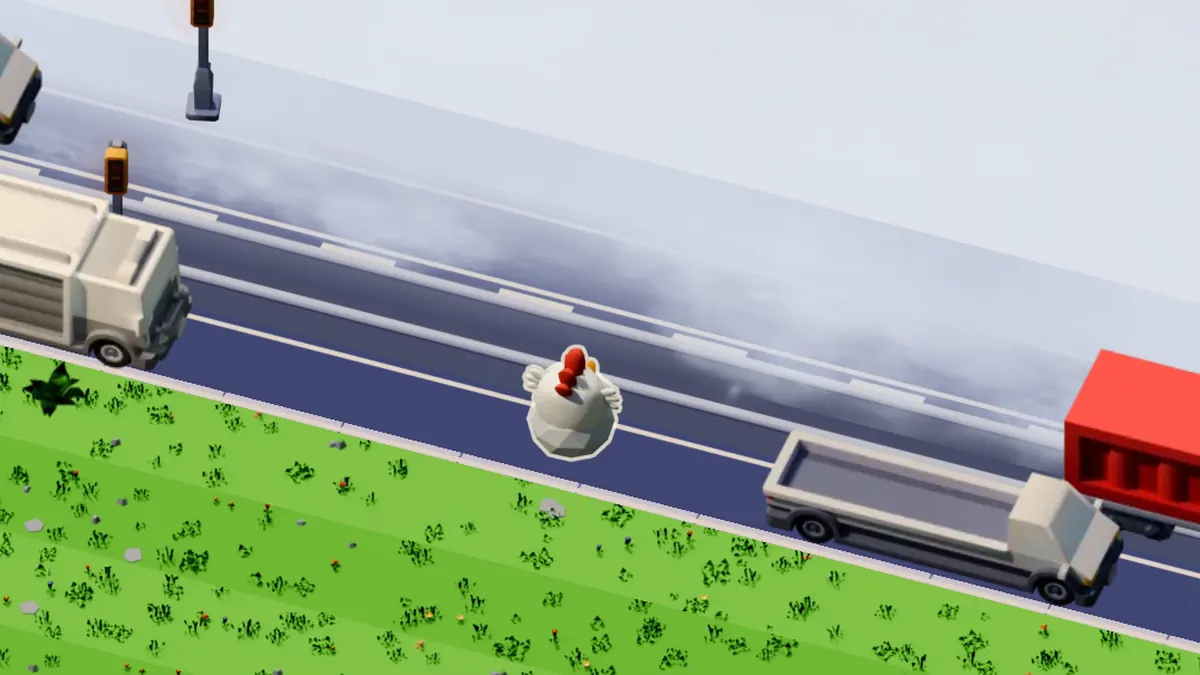
If you have been in an arcade, a bar or a pizza place since the early 1980s, you have probably seen Frogger. It is the cabinet where a small frog crosses a busy road, then a river, to reach one of five homes at the top of the screen, and every hop counts. Developed by Konami and released in 1981, with Sega/Gremlin publishing it in North America, it is often listed among the greatest video games ever made.
This guide covers how Frogger works, the timing technique that gets more frogs home, what the cabinet's settings change, and how a road-crossing game with published odds compares.
How the Frogger arcade game works
The frog starts at the bottom of the screen, below a road of race cars, dune buggies, trucks and bulldozers moving in opposing lanes.
Each move hops it one step. A vehicle that reaches the frog costs a life.
Past a median strip, the frog crosses a river by riding logs, turtles and alligators. Turtles can sink under it, and riding off the edge of the screen also costs a life.
A timer gives 30 seconds to guide each frog into one of five homes at the top. Filling all five moves you on to a harder level.
The game starts with three, five or seven frogs, depending on the machine's settings.
It is the same core mechanic as every road-crossing game: moving traffic, one hop at a time, and a mistake that costs you the run.
How to win at Frogger: timing habits that help
Traffic in a lane passes on a steady rhythm; waiting to see a gap open adds your whole reaction time.
Players who get the most frogs home are not reacting faster than everyone else. They are predicting better. Within a level, the traffic in each lane moves in a steady stream, so the moment a gap passes in front of you comes at a regular beat.
Hop on the rhythm, not on the picture. Watch a lane go past a few times and commit to the beat, instead of waiting until you see the gap open. By the time you see it, your reaction time has already made you late.
Watch the tail of the vehicle. It is easier to judge when the back of a vehicle clears your column than to track the front of the next one.
Use the median strip. It sits between the road and the river, so it is the place to pause and read the river before you commit.
Keep the same stance and hand. Timing is a mechanical skill, built by repetition. Changing how you stand or which hand you use resets part of it.
Practise for free first. Free browser and app versions of the same mechanic let you learn the rhythm without paying per go.
Is Frogger rigged?
It is a common question about arcade games, and for Frogger the honest answer is that it is not a prize machine. A credit buys a game and a score, not a prize, so there is no payout rate to tune. The settings that do exist, such as whether a game starts with three, five or seven frogs, are inside the cabinet, not on the screen.
Prize machines are a different matter. According to the operator's manual cited in Stacker's Wikipedia entry, the regular model of LAI Games' Stacker prize cabinet has a highest difficulty setting that targets roughly one major win in 800 plays. Other prize machines, such as claw cranes, work on a similar principle of operator-set payout rates. Whatever a given cabinet is set to, the problem is the same: you are paying to play against settings you cannot inspect.
Is Frogger a game of skill or chance?
The timing is skill. Crossing the road and the river is something you can practise and get consistently better at. Some things vary, such as a home that sometimes holds a bonus insect or a deadly alligator, and how many frogs you start with depends on settings the player cannot see. So Frogger is best treated as a skill test with a few surprises, and budgeted as entertainment.
What a road-crossing game with published odds looks like
The same hop-by-hop mechanic now exists as a real-money game where nothing about the odds is hidden. oncrosser is a skill gambling take on the road-crossing genre:
Each road has four lanes of cars, a river with drifting logs, or a railway, and you tap, press a key or swipe to hop one square at a time.
Like the arcade game, a mistimed hop costs you: a car or train reaching the piece, or water with no log under it, ends the round. Instead of a timer, a chaser follows you up the road, so you cannot wait forever for a perfect gap.
Every one of the 100 strips has a published chance that its road has no way through, starting at about 4.8 percent, and a published multiplier, starting at 1.05x. The whole ladder is visible before you stake.
On every road that has a way through, your timing decides whether you get across, so your timing changes your odds. The blocked roads and timing guide shows exactly how.
You can cash out on any grass strip you reach, and reaching strip 100 is worth 4,018,481.9022x the stake.
Every round is provably fair: the game commits to a secret seed before the round and reveals it when you rotate the seed pair, so you can verify the result yourself.
Feature | Frogger cabinet | oncrosser |
|---|---|---|
What you do | Hop a frog home | Hop across roads |
A bad hop | Costs a frog | Ends the round |
Reward | Points and levels | Cash out on any grass strip |
Odds shown | No | Full ladder |
Results checkable | No | Provably fair |
The trade-off is real money. oncrosser is gambling, it is for adults only, and it is not available everywhere.
Common questions about the Frogger arcade game
Who makes the Frogger arcade game?
Frogger was developed by Konami and released in 1981, with Sega/Gremlin publishing it in North America. It is often listed among the greatest video games ever made.
How do you win at Frogger?
Time your hops to the rhythm of each lane rather than reacting when a gap opens, use the median strip to reset, and keep your stance consistent. That gets more frogs home. Each time all five homes are filled, the game moves on to a harder level.
Is Frogger rigged?
Not in the way a prize machine can be: Frogger pays out a score, not prizes. Operators can still adjust settings such as the number of starting frogs, and players cannot see those settings.
Can you practise road crossing online?
Yes. Free browser and app road-crossing games, such as Hipster Whale's Crossy Road from 2014, are a good way to learn the rhythm before playing for money.
Is there a road-crossing game for real money with fair odds?
oncrosser uses the same timing mechanic for real money, with a published ladder, every hop checked against real traffic, and provably fair rounds. It is gambling, so only play with money you can afford to lose.
Playing responsibly
Whether it is an arcade cabinet or a real-money game, set a budget before the first hop and stop when it is gone. On oncrosser, the limits and cooldowns can hold you to it. If gambling stops being fun, free and confidential support is available from organisations such as BeGambleAware and the National Council on Problem Gambling.