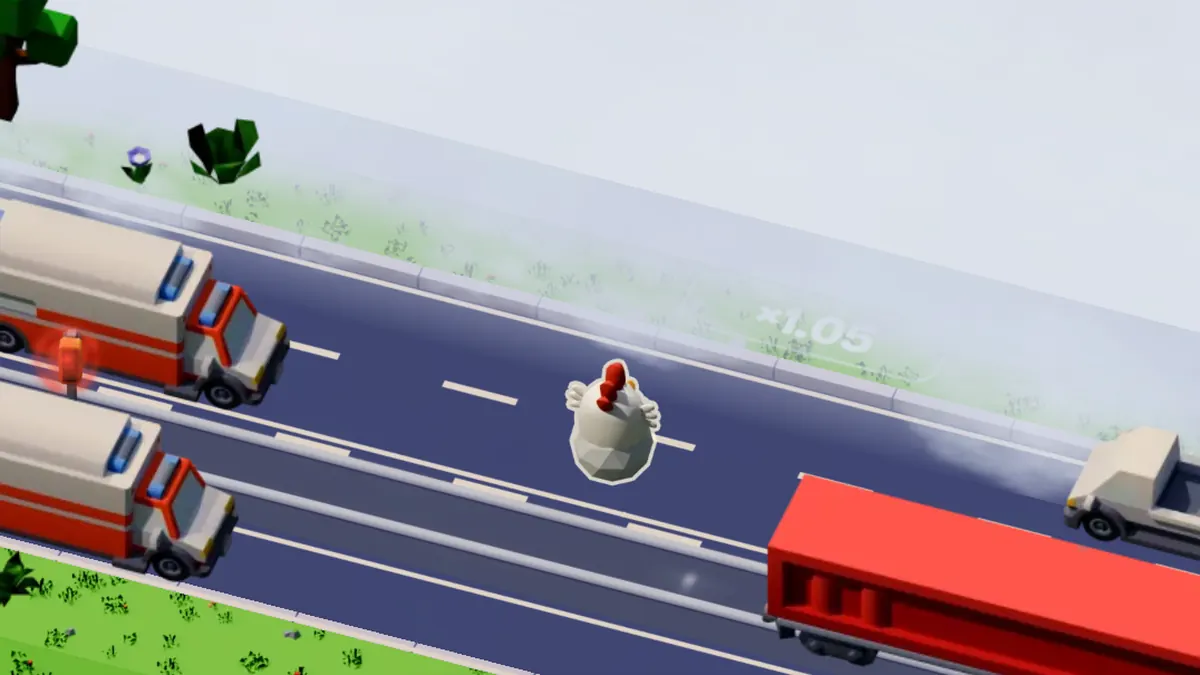
Road-crossing games have become a familiar format in crypto casinos. A character crosses a road one lane at a time, your multiplier grows with every lane you clear, and you can cash out whenever you like. Get hit and you lose the stake and everything the crossing was worth.
There are two very different kinds of road game hiding under that description. In the first, including chicken games such as Roobet's Mission Uncrossable, every lane is a hidden draw. In the second, every lane is a test of your timing. This guide explains how both work, what the maths looks like on each lane, and why no predictor can beat either one.
How a step-by-step road game works
Each step takes the character across one lane. Whether the lane hits you is decided by the game's random draw, and you cannot see it in advance. The only thing you choose is whether to take the next step:
Survive the lane and you move on to the next, where the multiplier is higher.
Get hit and the round ends, and the stake is lost.
After any lane you survive you can cash out and take the current multiplier.
Difficulty settings change the chance of being hit in each lane. An easy setting might let you survive nineteen lanes out of twenty. A hard setting might let you survive only three out of four, or fewer. Harder settings pay more per lane because each lane is less likely to be survived.
The maths on each lane
A fair road game pays exactly the inverse of your chance of surviving. With a 75 percent chance of surviving each lane, the fair multiplier for that lane is 4 divided by 3, about 1.33x. Lanes multiply together, so the chance of clearing ten lanes is 0.75 to the power of ten, about 5.6 percent, and the fair multiplier for getting there is about 17.8x.
The chance of clearing each further lane shrinks fast, which is why the fair multiplier climbs so quickly.
A casino does not pay the fair multiplier. It keeps a small share, which is the house edge. Here is what a 1 percent margin charged on every lane does at a 75 percent survival chance:
Lane | Chance to clear | Fair multiplier | Paid at a 1% margin |
|---|---|---|---|
1 | 75.00% | 1.33x | 1.32x |
3 | 42.19% | 2.37x | 2.30x |
5 | 23.73% | 4.21x | 4.01x |
8 | 10.01% | 9.99x | 9.22x |
10 | 5.63% | 17.76x | 16.06x |
When the edge is charged per lane, it compounds: by lane ten the player is getting back about 90 percent of the fair value, not 99 percent. Some games instead take the edge once from the final payout, which is cheaper for long crossings. The method varies from game to game, and it is worth knowing which one you are playing.
Is there a strategy for road-crossing gambling games?
In a step-by-step chicken game, the hits come from a random number generator, and each lane is independent of the ones before it. There is no pattern to read. The only real decisions are:
Which difficulty to play. This changes the variance, how big and how rare the wins are, not the edge.
When to cash out. This also changes variance. With a fixed edge per lane, stopping earlier costs less edge in total, but no stopping point turns the expected return positive.
Anything that promises more than that is selling something.
Why road game predictors do not work
Predictor apps and bots claim to know which lane is safe. They cannot. On a provably fair game, the result comes from a secret server seed that is only revealed later, combined with your client seed and a counter called a nonce through a cryptographic hash. Without the secret seed, the next result cannot be calculated, and the hash cannot be reversed. A predictor that asks for your account login, a deposit, or a fee is a scam, and some are built to steal accounts.
More on how these offers work in why chicken road predictors cannot work.
Timing roads: where the road responds to your hands
A timing road replaces the blind draw with a physical task. On oncrosser, each road has four lanes of cars, a river with drifting logs, or a railway, and you tap, press a key or swipe to hop one square at a time. Every hop is checked against the road's real traffic: a car or train reaching the piece, or water with no log under it, ends the round.
Each of the 100 strips still carries a published chance that its road has no way through, starting at about 4.8 percent on the first strip. The difference is that on every road that does have a way through, your timing decides whether you get across: a player who times every hop perfectly crosses it, and a mistimed hop ends the round. The multiplier starts at 1.05x on strip 1, and reaching strip 100 is worth 4,018,481.9022x.
That is what makes oncrosser skill gambling rather than another guessing game. Two players facing the same road fare differently because they time their hops differently.
Feature | Step-by-step chicken game | oncrosser |
|---|---|---|
What decides a lane | A hidden draw | Your hop + published odds |
Player changes odds? | No | Yes, through timing |
House edge | Varies by game | 0% base |
Main decision | When to stop | Timing + when to stop |
Checking results | Depends on the game | Always provably fair |
How cashing out works on a timing road
The cash-out decision is the same one as in any road game: bank the current multiplier or risk it on the next road. What changes is that your timing should shape it. With perfect timing on oncrosser, the expected return is the same 100 percent at every strip, so cashing out early or late only changes variance. With mistimed hops, the cost grows the further you cross, so a player whose timing is slipping should stop earlier. You also decide before you see the next road, because the cash-out window shows only its first lane. The cashout guide shows how the amount is calculated.
Common questions about road-crossing casino games
What is a road-crossing casino game?
A game in which you cross a road lane by lane for a rising multiplier and can cash out at any time. Most versions only ask you to take the next step, with each lane's result drawn at random. Timing versions ask you to hop through moving traffic instead.
Is there a winning strategy for road-crossing games?
Not in a step-by-step chicken game, where each lane is random and the edge is fixed. Difficulty and cash-out choices change variance, not the long-run cost. In a timing road, better timing genuinely improves your odds.
Do chicken game predictors work?
No. On a provably fair game the result depends on a secret seed that is only revealed later. Predictors cannot calculate it, and many are scams designed to take deposits or account details.
Which difficulty is best?
None is better in the long run when the edge is the same at every level. Easier settings give frequent small wins; harder settings give rare large ones. Choose the pattern you are comfortable with and a budget you can afford to lose.
Is oncrosser a road-crossing game?
Yes, a timing-based one. You cross up to 100 roads, every hop is checked against real traffic, and you can cash out on any grass strip you reach.
Playing responsibly
Road-crossing games are fast, and a rising multiplier makes it tempting to cross one more lane. Decide your stake and your stopping point before the round starts, and use the limits and cooldowns if a session stops being fun. If gambling stops being fun, free and confidential support is available from organisations such as BeGambleAware and the National Council on Problem Gambling.