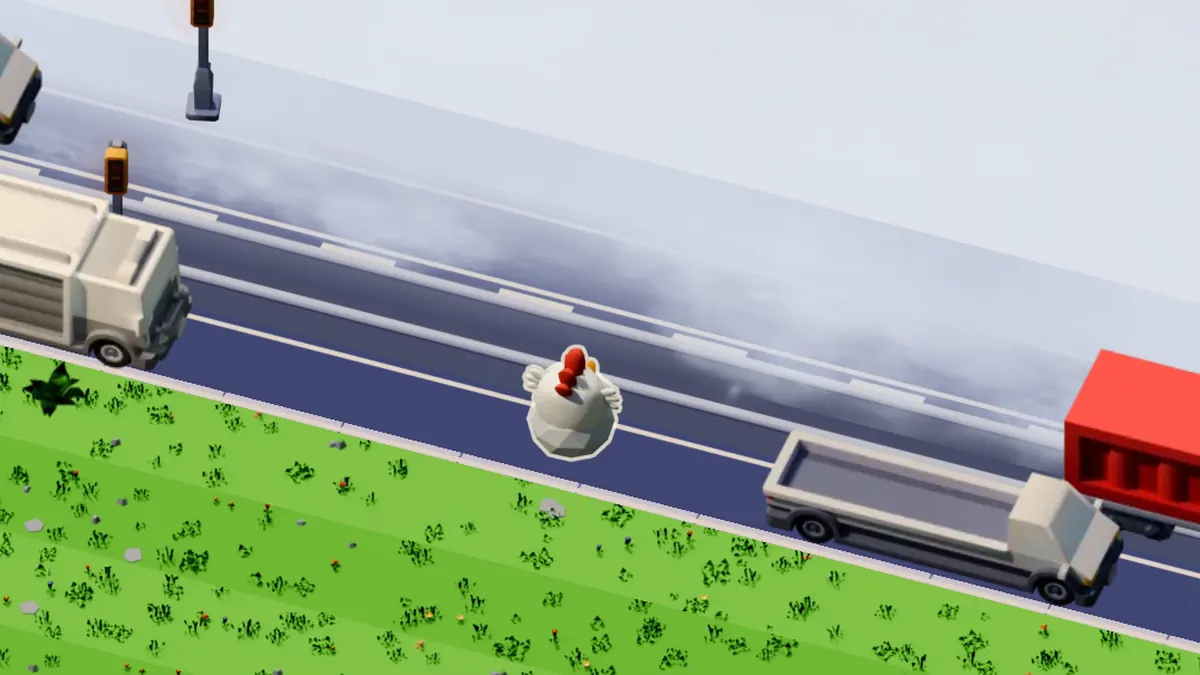
The road-crossing game is one of the simplest ideas in gaming. A character waits at the edge of a busy road and you move it one hop at a time. Time a hop into a gap and you get closer to the other side. Hop into traffic, or into the water, and the run is over. Each level usually brings faster traffic or narrower gaps, until one mistimed hop ends the run.
That simplicity is why the idea keeps coming back, from arcade cabinets to phone apps to real-money games.
How to play a road-crossing game
The rules barely change between versions:
Traffic moves along each lane at a steady speed.
You tap, click, swipe or press a key to hop one square.
Wherever you land is where you stand until the next hop.
Mistakes are punished, either by sending you back or by ending the run.
Each new road or level is busier, and often faster, than the last.
There is no strategy screen and no menu of choices. The whole game is the timing of one input, repeated.
How to cross more roads: six timing habits
The players who cross the most roads are not reacting faster than everyone else. They are anticipating better. Hand-eye coordination in a road-crossing game is mostly prediction: your eyes track the traffic, your brain projects where the gap will be, and your finger commits in advance.
Hop to the rhythm, not the picture. Each lane moves at a steady speed, so its gaps pass at regular intervals. Count the beat and hop on it rather than waiting to see the gap open.
Watch the back of the car, not the front. It is easier to judge the moment a car's tail clears your square than to guess when the next one will arrive.
Commit early. A late, hesitant hop is the most common mistake. Decide on the gap before it reaches you.
Keep the same setup. Same device, same hand, same seat. Mechanical skill is built on repetition, and changing the setup resets part of it.
Reset after a near miss. One close call tempts a rushed hop into the next lane. Treat the next lane as a fresh rhythm.
Stop when tired. Timing is the first thing fatigue takes, so short sessions beat long ones.
The road-safety version: the Green Cross Code
Some people searching for a road-crossing game mean a road-safety lesson, not a video game. In the UK, the Green Cross Code has taught children to cross since 1970. Its current steps:
Think: find the safest place to cross.
Stop: stand on the pavement near the kerb.
Use your eyes and ears: look all around for traffic, and listen.
Wait until it is safe to cross, and let approaching traffic pass.
Look and listen again, then cross straight over without running.
Arrive alive: keep looking and listening while you cross.
It is the same idea as the video game, a road that has to be read before every step, tested with patience instead of timing. On a real road, the patient choice is always the right one.
Where the road-crossing game came from
Video games took the idea up in 1981. Konami's Frogger, published in North America by Sega/Gremlin, sent a frog across a busy road and then a river of logs, turtles and alligators to reach five homes. The same year Activision's Freeway for the Atari 2600, designed by David Crane, had chickens cross a ten-lane freeway against the clock, a nod to the old joke about why the chicken crossed the road. In 2014 Hipster Whale's Crossy Road turned the idea into an endless phone game of roads, rivers and train tracks. Every version tested the same thing: timing under rising pressure.
The real-money road-crossing game on oncrosser
oncrosser keeps the core moment and adds stakes, published odds and a cash-out.
A round runs to 100 strips. Each grass strip you reach multiplies your stake, from 1.05x on the first strip to about 1.18x per strip from strip 12 on, and reaching strip 100 is worth 4,018,481.9022x.
As in the classic game, a mistimed hop ends the run: a car or train reaching the piece, or water with no log under it, ends the round.
Each lane keeps its own steady speed of 1.5, 2 or 4 cells per second, and cars never speed up or react to you. Trains are announced by warning lights 2.5 seconds ahead. Every hop is checked against the same traffic you see, with the same rules.
Every road carries a published chance of having no way through, starting at about 4.8 percent and rising to 15 percent from strip 12 on. A chaser follows you up the road, so you cannot wait forever for a perfect gap.
On any grass strip you reach, you can cash out in the short window before your next hop and take the current multiplier.
That last point changes how the game is played, and it is what turns a road-crossing game into skill gambling: your timing and your stopping point both decide the result. In the arcade you cross until you fail. On oncrosser the real decision on every strip is whether the next road is worth the risk. The cash-out guide explains how the amount is calculated, and road-crossing game explained covers a round road by road.
How the timing habits translate to real stakes
A road with a way through can be crossed every time by a player who times every hop perfectly; a road with none cannot be crossed by anyone.
The six habits matter more when real money rides on every hop. On oncrosser a mistimed hop ends the round at once, and the multipliers are set so that a player who never makes a mistake gets back, on average, exactly what they stake at every strip. Modelled on the live ladder, that player cashing out at strip 10 gets back 100 percent of stakes over the long run. A player who mistimes one crossable road in fifty gets back about 82 percent at the same cash-out point, and one who mistimes one road in twenty about 60 percent. The blocked roads and timing guide has the full rules.
Chance never goes away. Even a perfect crossing leaves the next road's published chance of having no way through, so a round can end on any road. Skill decides how much extra risk you add, not whether risk exists.
Free road-crossing games versus the real-money version
Free versions are the right place to learn the rhythm: nothing is at stake, and a failed run costs only time. The real-money version is a different product. It is gambling, it is for adults only, and it is not available everywhere. If you move from one to the other, treat your first sessions as practice at the smallest stake.
Common questions about the road-crossing game
What is the road-crossing game?
A timing game in which you hop a character across lanes of moving traffic, trying to land every hop in a gap. A mistimed hop sends you back or ends the run.
What is the trick to a road-crossing game?
Rhythm. Each lane moves at a steady speed, so hop on the beat of its gaps rather than reacting when one opens, and keep your setup identical from run to run.
Is there a road-crossing game for real money?
Yes. oncrosser, also written OnCrosser, is a real-money road-crossing game. It has 100 strips, a published ladder and a cash-out on every grass strip you reach.
How far can you cross?
On oncrosser a round has 100 strips, and reaching strip 100 pays 4,018,481.9022x the stake. Almost nobody reaches it: even with perfect timing, a round reaches strip 50 less than 1 time in 1,000.
Is the road-crossing game skill or luck?
The free versions are a test of skill for a score. The real-money version is both: your timing decides how much risk you add, and a published chance that a road has no way through applies on every road regardless.
Playing responsibly
A road-crossing game played for money is still gambling. Set a limit before your first hop, cash out rather than chasing one more road, and use the limits and cooldowns if a session stops being fun. If gambling stops being fun, free and confidential support is available from organisations such as BeGambleAware and the National Council on Problem Gambling.