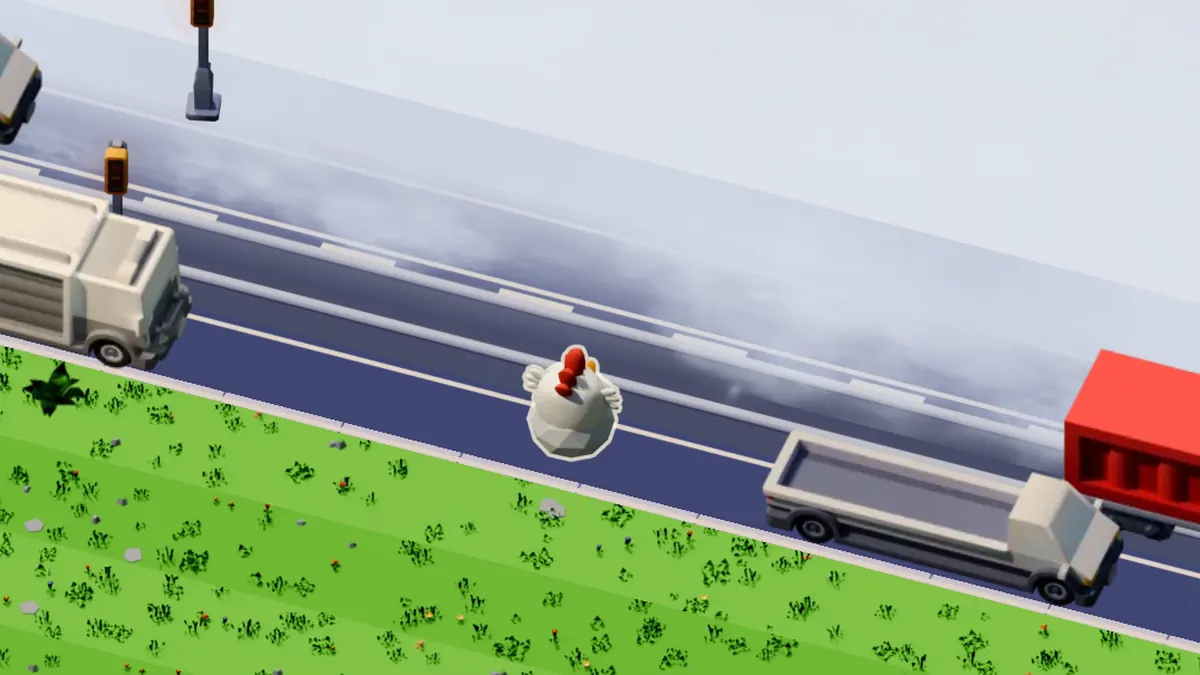
Search for a chicken road game strategy and you will find hundreds of tips, tricks and systems. Most of them cannot work, because in most chicken games nothing you do changes the result of a lane. A real-time chicken crossing game is different: your timing decides whether you get across. This guide separates the two and gives you the habits that do make a difference.
Two kinds of chicken road game
Most chicken games in crypto casinos, such as InOut Games' Chicken Road, Chicken on Stake or Roobet's Mission Uncrossable, are step games. You press a button, the chicken steps into the next lane, and a random draw decides whether that lane hits you. You cannot see the draw, and the lanes do not depend on one another.
oncrosser is a real-time chicken crossing game. The chicken hops one square at a time through moving cars, rivers with drifting logs and railways, and every hop is checked against the traffic that is really there. Some roads have no way through at all, with a published chance for every strip; on every other road, a player who times every hop perfectly gets across.
Question | Step chicken game | oncrosser |
|---|---|---|
Can timing change a lane? | No | Yes |
Can you see the danger? | No, it is a hidden draw | Yes, the traffic is on screen |
What can strategy change? | Variance only | Timing and variance |
House edge | Set by the game | 0% base on perfect play |
How a round of oncrosser plays
You choose a stake and start on grass. Each tap, key press or swipe is one hop forward, back, left or right, and a hop takes 0.15 seconds. Each road has four lanes between two strips of grass, and every lane is cars, a river with logs, or a railway. Reaching the next grass strip raises your multiplier, from 1.05x on strip 1 to 4,018,481.9022x on strip 100.
When you land on grass, a short cash-out window opens. It shows the first lane of the next road while the rest is under mist, and it closes at your first hop or 0.3 seconds after landing. A chaser follows you up the road: it reaches your grass 5.2 seconds after you land, then moves one row every 1.5 seconds, so you cannot wait forever. The full rules are in how an oncrosser round works.
Timing tips for a real-time chicken crossing game
These habits come from how the road is built. Every lane has one steady speed, no car ever speeds up or reacts to you, and nothing you do changes the traffic that is drawn.
Read the lane type first. Cars, logs and trains need different timing. Look at the whole road before the first hop, not one lane at a time.
Hop on the rhythm. A lane's gaps pass at regular intervals, because each lane has one speed. Count the beat and commit as the gap arrives instead of waiting to see it open.
Use the hop length. A hop lasts 0.15 seconds. Leave enough room for the whole hop, not just for the moment you press.
Press once. One press made during a hop is kept and carried out when you land. Extra presses are not queued, so mashing only adds mistakes.
Treat logs as moving ground. A log carries the chicken with it. Watch where it is taking you and step off onto the next log or grass in time.
Respect the warning lights. Trains are announced by lights 2.5 seconds before they reach the crossing. Lights on means wait.
Use side steps. Moving one column left or right often lines you up with a gap sooner than waiting in place.
Keep the chaser in mind. Taking your time on grass is fine, but the chaser arrives 5.2 seconds after you land.
Better timing is a skill you can train. The hand-eye coordination guide explains what timing games actually measure and how to practise it.
When to cash out
With perfect timing on oncrosser, the expected return is 100 percent of the stake at every strip, because each strip's multiplier is set from the published chance that its road has no way through. Cashing out early or late then only changes variance: early cash-outs are small and frequent, late ones are large and rare.
Mistimed hops change that. Every mistake is a loss that the multiplier does not pay for, so the further you go with slipping timing, the more you give up. Three habits follow:
Set a cash-out target before the round, and keep it unless you have a reason to change it.
Cash out earlier when your timing feels off, when you are tired, or after a near miss.
Remember that you decide on the grass, before you see the whole next road: the window shows only its first lane.
The maths behind cash-out targets is in cash-out strategy for multiplier games and how cashout and multipliers work.
Chicken road tricks that do not work
Patterns and streaks. Each road is drawn from the round's seed. A blocked road last round says nothing about the next one.
Doubling after a loss. Martingale and similar systems change the size of your swings, not the house edge, and they can empty a balance quickly.
Best time of day. The rules and the draw are the same at every hour.
Predictor apps and hacks. They cannot see a secret seed. See why chicken road predictors cannot work.
Common questions about chicken road game strategy
Is there a trick to win the chicken road game?
No trick guarantees a win. In step games there is nothing to time, so only the stake and the stopping point are yours. On oncrosser, good timing gets you across every road that has a way through, but some roads have none, so every round can still be lost.
What is the best chicken road strategy?
Choose a stake you can afford to lose, set a cash-out target before the round, and on a real-time game, time each hop on the lane's rhythm rather than reacting late.
When should I cash out?
At the target you set before the round, or earlier when your timing slips. With perfect play the long-run return is the same at every strip, so the target is about how much variance you want.
Can a strategy make chicken road profitable?
No strategy turns gambling into income. On oncrosser the base house edge is 0% on perfect play, which means perfect timing breaks even on average; it does not make money on average.
Is there a free way to practise?
Free arcade road-crossing games train the same timing. The road-crossing game guide compares them with the real-money version.
Playing responsibly
A strategy is no reason to stake more than you planned. Decide your budget and your stopping point before you start, and use the limits and cooldowns if a session stops being fun. If gambling stops being fun, free and confidential support is available from organisations such as BeGambleAware and the National Council on Problem Gambling.