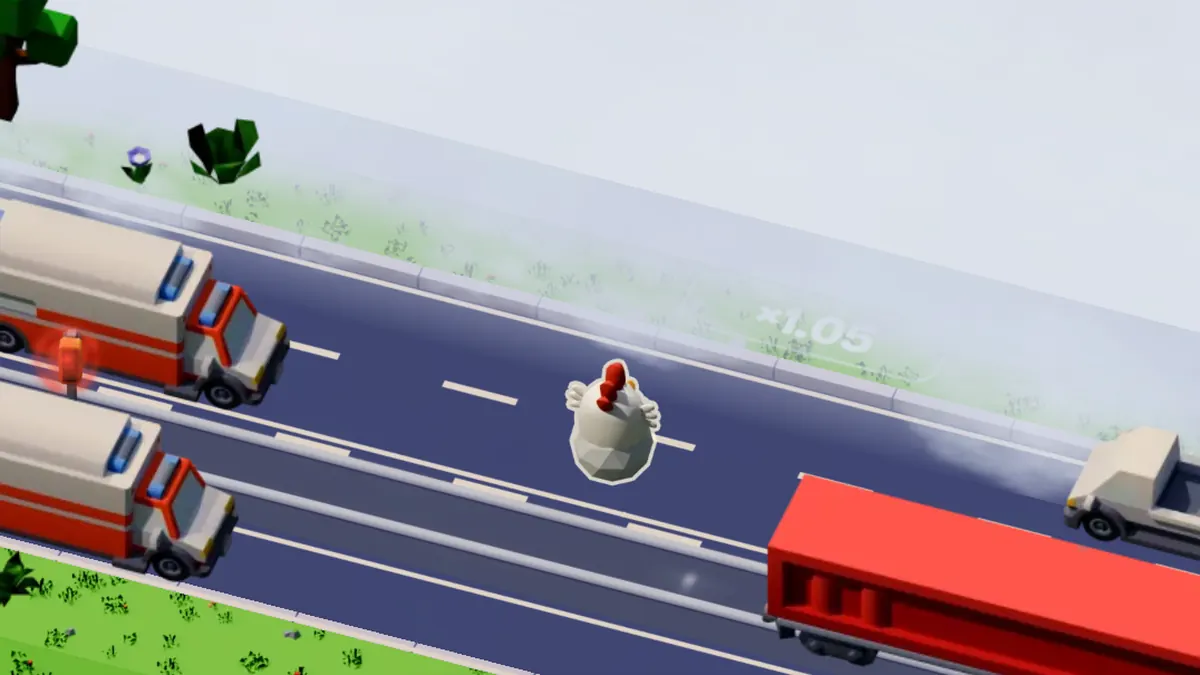
An oncrosser round is a sequence of road crossings. You choose a stake, start on the grass, and hop forward one square at a time across roads of traffic lanes, rivers with drifting logs, and railway tracks. Every road ends at a strip of grass, and every grass strip you reach raises the multiplier. On the grass you decide whether to cash out or carry on.
Before the round starts
oncrosser is a real-money gambling product. Before playing, confirm that you are eligible, that the selected currency is available, and that your stake is within the limits shown in the product. A valid-looking amount in the browser is not enough: the authoritative service still checks the round request, account status, balance, personal limits, and current game configuration.
Read the game and risk disclosures and decide what you can afford to lose in full. Every strip's multiplier is published in the How it works section.
Starting the round
When a start request is accepted, the stake is held for a new round and the game returns the information needed to play it. That includes the round identifier, the nonce, and the seed hash: the SHA-256 commitment to the server seed that decides every road of the round. The server seed itself stays on the server while it is in use, so it cannot be used to preview the roads ahead.
The piece then stands on the starting grass. Each tap, key press or swipe is one hop forward, back, left or right, taking 0.15 seconds. The round service checks every hop against the same rules, so a move is never decided by one rendered browser frame.
Crossing each road
Each road has four lanes between two grass strips: cars, a river with drifting logs, or a railway whose trains are announced by warning lights. A car or train that reaches the piece, or water without a log under it, ends the round.
All traffic is drawn from the round's seed. Some roads have no way through however well you play, with a published chance for every strip; most lost rounds are timing mistakes instead. See blocked roads and timing.
How road risk and multiplier growth interact
Each strip has a published chance that its road has no way through and a matching multiplier. If you reach the strip's grass, its multiplier becomes the round's current multiplier; if you are hit or lost, the round ends with no cashout amount.
Current multiplier = the published multiplier of the furthest grass strip reached
Potential cashout amount = stake × current multiplier
The chance of a road with no way through rises from 1 in 21 on the first strips to 15% from strip 12 on. The multiplier can become very large because it reflects every road crossed so far, not because reaching a high strip is likely. See what 0% house edge means for the probability and multiplier relationship.
When cashout becomes available
Cashout is available in the cash-out window that opens when you land on grass. While it is open you see the next road's first lane; the rest is under mist. The window closes at your first hop or 0.3 seconds after landing, and then the mist lifts.
Until a cashout request reaches an authoritative terminal state, treat the displayed figure as potential. Cashout is also different from withdrawing to an external wallet; see cashout and multipliers.
How a round ends
A round stops through one of these terminal paths:
Cashout: an accepted cashout in a cash-out window ends and settles the round.
Hit: a car, a train, the river, or the chaser that follows you up the road (it reaches your grass 5.2 seconds after you land, then one row every 1.5 seconds) ends the round with zero.
Final-strip win: reaching the last grass strip completes the round as a win.
The current public configuration contains 100 strips. Rules can change, so use the live product and current public table rather than treating an old screenshot or article example as the active contract. Once a round is complete, its seed proof and recorded hops can be checked using the round verification guide.
Before you play
Choose a stake you can afford to lose completely.
Read the next strip's chance and the multiplier together.
Set a cashout point, loss limit, and session limit before the round.
Do not chase a loss or treat a previous outcome as a prediction.
Use a cooldown or stop playing if the session is no longer entertainment.
Learn about limits, cooldowns, and self-exclusion, or visit the oncrosser FAQ for product questions.
Methodology and change control
This article was reviewed on against the current public game configuration, the round commands, the road generator and hop rules, the ladder, the cashout rules, and terminal settlement behavior.
It explains the product flow; it does not predict outcomes or provide a winning strategy. If the active round rules change materially, the examples and last-reviewed date must change too.