Crash games, road-crossing games and other multiplier games, oncrosser among them, all come down to one decision: when do you cash out? The multiplier climbs, the chance of losing everything climbs with it, and every player has a theory about the right moment to stop. Most of those theories do not survive contact with the maths.
This guide explains what the numbers actually say about cash-out targets, auto cash-out and betting systems, and the one kind of multiplier game where your own skill genuinely changes the answer.
How multiplier games work
You place a stake and a multiplier starts rising, or a piece starts crossing the road.
At any moment you can cash out and take your stake times the current multiplier.
If the round ends before you cash out, the crash, the trap or the hit, you lose the stake.
The longer you wait, the bigger the payout and the smaller the chance of reaching it.
The key fact: every target costs the same
In a typical crash game with a 1 percent house edge, the chance of the multiplier reaching any target is 0.99 divided by that target. That single formula explains why no target is better than another on average:
Target | Chance to reach | Expected return |
|---|---|---|
1.2x | 82.5% | 0.99 |
1.5x | 66.0% | 0.99 |
2x | 49.5% | 0.99 |
5x | 19.8% | 0.99 |
10x | 9.9% | 0.99 |
100x | 0.99% | 0.99 |
Whatever you aim for, you expect to get back 99 percent of what you stake over the long run: the expected value is the same. The target only changes the shape of the results: a 1.2x player sees a steady trickle of small wins punctuated by losses, while a 100x player loses almost every round and occasionally wins big.
Does auto cash-out help?
Auto cash-out does not change the odds, but it does remove two things that cost players money: slow reactions and changing your mind mid-round. Setting a target before the round and letting the game execute it is the most disciplined way to play a crash game. It is not a way to win.
Do betting systems work?
Doubling your stake after every loss, the Martingale system, feels unbeatable because it produces long runs of small wins. The problem is the rare losing streak. At a 2x target, the chance of losing seven rounds in a row is under 1 percent, but when it happens you have staked 1, 2, 4, 8, 16, 32 and 64 units, 127 in total, to chase a 1-unit profit, and the next bet would be 128. Every system of this kind turns many small wins into occasional large losses with the same average cost.
Stop-loss and take-profit limits are different. They do not change the maths either, but they do protect you from yourself, which is what a strategy should really do.
Where skill changes the answer
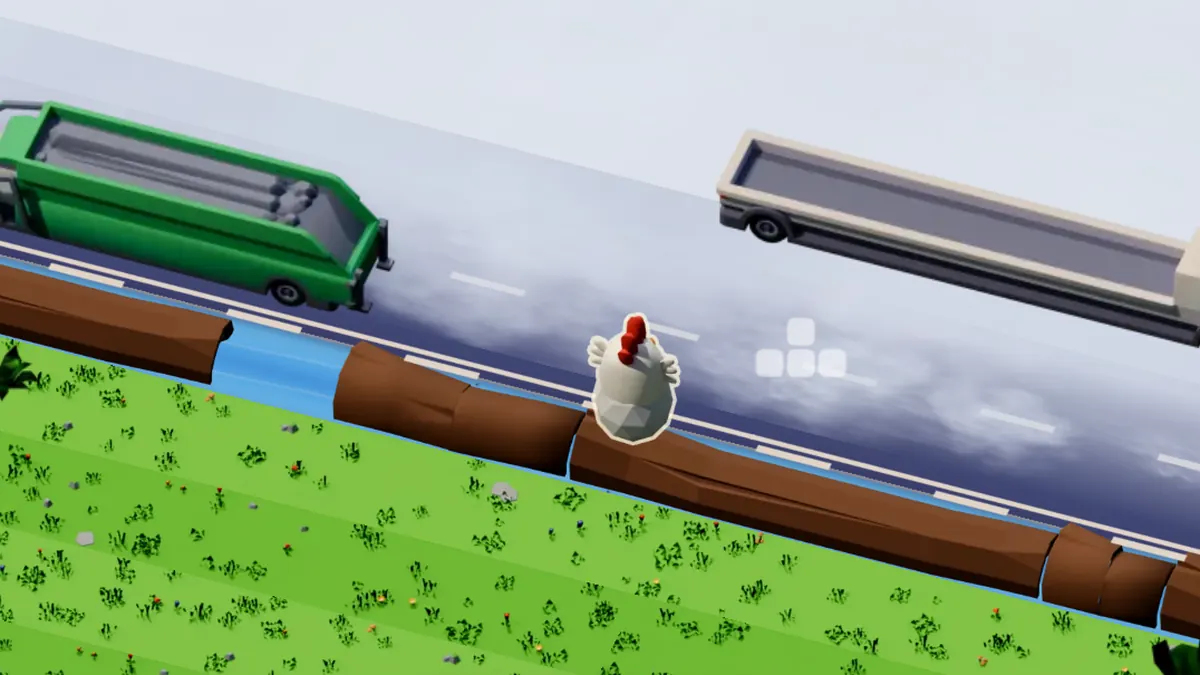
Everything above assumes the odds are fixed whatever you do. In a timing game they are not. On oncrosser you cross each road hop by hop, and a hop into a lane a moment too early, a misjudged log or a wait that lets the chaser reach your row ends the round, even on a road that had a way through. The base house edge is zero, so with perfect play every cash-out point has the same expected return of 100 percent. With timing mistakes, the cost grows the further you go, because every extra road is another chance to make one.
This is the published ladder for a player who always cashes out at the same strip:
Strip | Multiplier | Chance of reaching it on perfect play | Long-run return on perfect play |
|---|---|---|---|
3 | 1.1576x | 86.38% | 100% |
5 | 1.2762x | 78.35% | 100% |
10 | 1.8422x | 54.28% | 100% |
20 | 9.0693x | 11.03% | 100% |
That gives oncrosser a cash-out rule that crash games cannot have: go only as far as your timing supports. A player reading lane speeds and car lengths cleanly, and hopping into gaps with time to spare, can aim higher at little extra cost. A player who is rushing hops or misjudging logs is paying more for every extra road, and should bank earlier. It is the practical side of skill gambling: your timing sets the price of ambition.
oncrosser adds one more reason to decide early. Cash-out is only possible in the window that opens when you land on grass, and it closes at your first hop or 0.3 seconds after you land. While it is open you see only the first lane of the next road. You decide first and see second, so pick your stopping strip before the round, not on the grass.
Variance still applies at every level. Even with perfect play, a round reaches strip 10 only 54.28 percent of the time and strip 20 about 11 percent of the time. The cashout guide explains how the amount is calculated and when cash-out becomes available.
Common questions about cash-out strategy
Is there a winning strategy for crash games?
No. With a fixed house edge, every cash-out target has the same expected return. Targets, auto cash-out and stop limits change how a session feels and protect your budget, but they cannot turn the expected return positive.
What multiplier should I cash out at?
In a fixed-edge game, the one that suits your budget and patience: low targets for frequent small wins, high targets for rare large ones. On oncrosser, pick a strip that matches how cleanly you are timing your hops.
Does the Martingale system work in crash games?
It produces many small wins and occasional very large losses, with the same average cost. Table limits and bankroll limits eventually stop the doubling, usually at the worst moment.
When should I cash out on oncrosser?
When your timing stops supporting the next road, and decide it before you land. With perfect play, stopping early or late only changes variance. When your hops are getting rushed or you are misjudging logs, every extra road costs more, so bank sooner.
Playing responsibly
A rising multiplier is designed to make stopping hard. Decide your target and your budget before the round starts, use auto cash-out or a firm rule, and on oncrosser use the limits and cooldowns if you need them. If gambling stops being fun, free and confidential support is available from organisations such as BeGambleAware and the National Council on Problem Gambling.