Every casino game has a price, and the house edge is it: the share of each stake the game is designed to keep over the long run. Players look for low-edge games for exactly that reason. A no house edge casino game, sometimes called zero edge gambling, is the end of that search: a game whose base maths keeps nothing at all. This guide explains how rare that is, how it compares with the lowest-edge games you can play, and how to check that a zero house edge claim is real.
The lowest house edges in a normal casino
Even the best-value casino games keep something. Typical figures, in line with the published house edges for each game:
Blackjack with perfect basic strategy: around 0.5 percent
Baccarat, betting on the banker: about 1.06 percent
Craps, pass line: about 1.41 percent
European roulette: about 2.7 percent
American roulette: about 5.26 percent
Online slots: commonly 2 to 10 percent
Crypto dice and crash games: commonly 1 to 3 percent
Those numbers look small. They are not, because the edge is charged on volume. A player who wagers 1,000 units a night on a 2.7 percent game expects to hand back about 27 units a night on average, however the individual spins fall. Over a year of regular play, that is the largest cost in the hobby.
The one zero-edge bet in a normal casino
There is exactly one well-known bet on a traditional casino floor with no house edge: the craps odds bet. Once a point is set, you can back a pass or come bet with an extra wager that is paid at the true odds of the point being made, so it keeps nothing for the house. The catch is that you can only place it on top of a pass or come bet, which carries an edge of about 1.41 percent, so the combination is never quite zero. Every other game on the floor, including blackjack and baccarat, keeps something.
What no house edge actually means
A game has no house edge when its base return to player is exactly 100 percent. Over a very large number of rounds, the maths expects to pay back everything wagered, and nothing is skimmed from the probabilities.
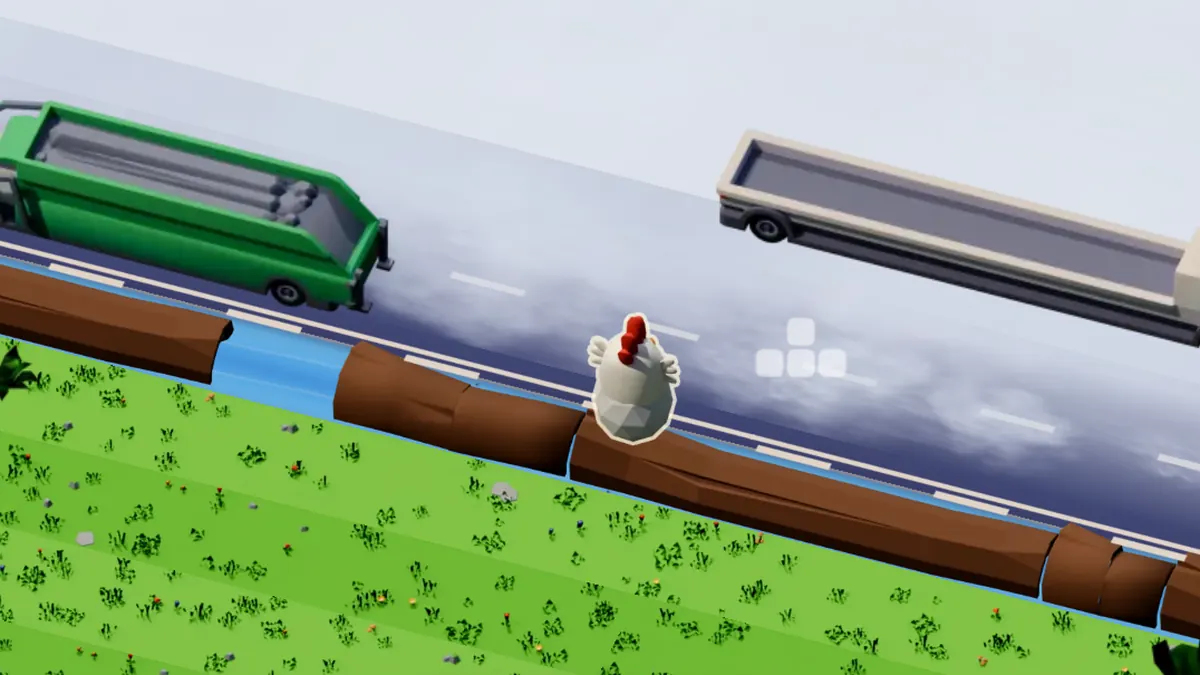
On oncrosser, each of the 100 strips pairs a published chance that its road has no way through with a multiplier, and the live configuration sets the house edge to 0%. You can check it yourself, because zero edge has a simple arithmetic test: a strip's chance of being reached on perfect play multiplied by its multiplier must equal 1.
Strip 1: chance of no way through 4.7619 percent, multiplier 1.05x. Chance of reaching it 0.952381 × 1.05 = 1.000000.
Strip 10: chance of no way through 10 percent, multiplier 1.8422x. Chance of reaching it 0.542818 × 1.8422 = 1.0000, allowing for rounding down.
Strip 100: chance of no way through 15 percent, multiplier 4,018,481.9022x. Chance of reaching it 0.00000024885 × 4,018,481.9022 = 1.0000, allowing for rounding.
A game that kept a 1 percent margin on every road would show 0.99 for strip 1 instead. That single number is the whole difference, and it compounds: over 100 strips a 1 percent margin per road leaves a base return of about 37 percent.
Why a no house edge casino game still has risk
Zero edge describes the average over a huge number of rounds. It says nothing about the next one.
Every road can end the round. The first road has no way through about 4.8 percent of the time, and the chance rises as you go, to 15 percent on every road from strip 12 on.
Variance is large. Even with perfect play, a round reaches the 1.8422x cash-out at strip 10 only 54.28 percent of the time. The long-run average is 100 percent; any single session can sit well below it.
The base maths is not the whole game. A hop into a lane a moment too early, a misjudged log or letting the chaser reach your row ends the round on a road that had a way through, and that is where a long-run cost can appear.
Where the cost goes when the house takes nothing
In a conventional casino the house edge is fixed: the same for a beginner and an expert. With a zero base edge, the long-run cost depends on how you play. oncrosser judges every hop against the road's real traffic, and most lost rounds are not blocked roads but timing mistakes. A player who always cashes out at strip 10 gets back 100 percent on average with perfect play; every round lost to a mistake on a road that could be crossed takes that return below 100 percent. The skill gambling guide explains the skill side in full.
In other words, a zero house edge moves the price of the game from the operator to the player's timing. For a precise player that is a better deal than any edge in a normal casino. For a careless one it can be a worse deal than roulette. That trade is what makes oncrosser skill gambling rather than a pure game of chance.
Three checks for any zero house edge claim
Zero edge is easy to advertise, often as a short promotion on a single game. Before you trust a claim, check three things.
Is the full ladder published before you bet? You should see every road's chance and multiplier, and be able to run the chance × multiplier = 1 test yourself.
Can completed rounds be verified? A provably fair game commits to a hidden server seed before the round, mixes in your own client seed, and reveals the server seed afterwards so you can recompute every result.
Does it apply to every round, all the time? A zero-edge weekend on one game is a promotion. A zero-edge configuration that is published and applied to every round is a product.
No house edge versus low house edge: which is better for players?
On the base maths, zero beats any positive number, and the gap grows with volume. But the edge is one factor among several. Variance, your own decisions and, on oncrosser, your timing matter more to any single session than the headline figure. The honest summary: a genuine no house edge casino game removes the built-in cut and leaves you with the published risk and your own skill.
Common questions about no house edge casinos
Are there casino games with no house edge?
Very few. Some operators run zero-edge promotions on individual games. oncrosser sets the base house edge to zero across its whole game in the live configuration, and publishes the ladder so the claim can be checked.
If the house edge is zero, where does the cost come from?
Not from the base maths of the round, which keeps nothing. On oncrosser, any long-run cost comes from timing mistakes that end rounds on roads that had a way through, on top of the published chances.
Is a 0% house edge the same as 100% RTP?
Yes, for the base maths. House edge and return to player describe the same thing from opposite sides: a 0 percent edge is a 100 percent base RTP.
Does zero house edge mean I will break even?
No. It describes the long-run average across an enormous number of rounds. Individual sessions swing widely, and mistimed hops lower your return below the base 100 percent.
Is oncrosser a no house edge casino?
oncrosser runs its road-crossing game with a configured base house edge of zero on all 100 strips. That is a statement about the published maths, not a promise of profit.
Playing responsibly
A zero house edge does not make gambling safe, and it is not a reason to stake more. The chance that a road has no way through is published for every strip, real and unchanged by the edge figure. Set a budget before you play, and use the limits, cooldowns and self-exclusion tools if a session stops being entertainment. If gambling stops being fun, free and confidential support is available from organisations such as BeGambleAware and the National Council on Problem Gambling.